
Inside Sourcefit’s AI Work
A Sourcefit staff survey offers one provider’s view of AI at work—and practical questions Filipino job seekers and BPO buyers can ask.
Sourcefit AI work combines custom automation with outsourced teams, while keeping people involved where a task needs human review. Its survey of staff across four countries suggests many respondents see productivity gains, but the findings represent one provider’s employees—not the whole outsourcing industry.
That distinction matters for Filipino job seekers weighing how AI may affect BPO and offshore roles. The company’s survey ran from February to July 2026 across the Philippines, South Africa, the Dominican Republic and Madagascar, with 1,860 respondents in staff augmentation roles managed by clients. Only 7% said AI might reduce or eliminate parts of their role; 68% reported moderate or significant productivity improvements. That makes Sourcefit AI work a useful example to examine, not a promise about every job or employer.
Sourcefit is a global outsourcing company led by founder and CEO Andy Schachtel. For a wider look at the Philippine IT-BPM community, see our overview of what Lyriq AI’s IBPAP membership signals for Filipino professionals.
Source: Inside Sourcefit’s AI Work
What Sourcefit AI work includes
Sourcefit describes WorkingAI as a managed service that designs and implements custom AI within a client’s existing operations, often alongside outsourced staff. Its stated approach pairs the technology with expert teams, so a person remains in the loop when human judgment or review is needed. The company says its WorkingAI Accelerator Program normally gets a client onto new, optimized processes in less than 30 days.
“Ask what the technology changes in the day-to-day work—not just whether an employer uses AI.”
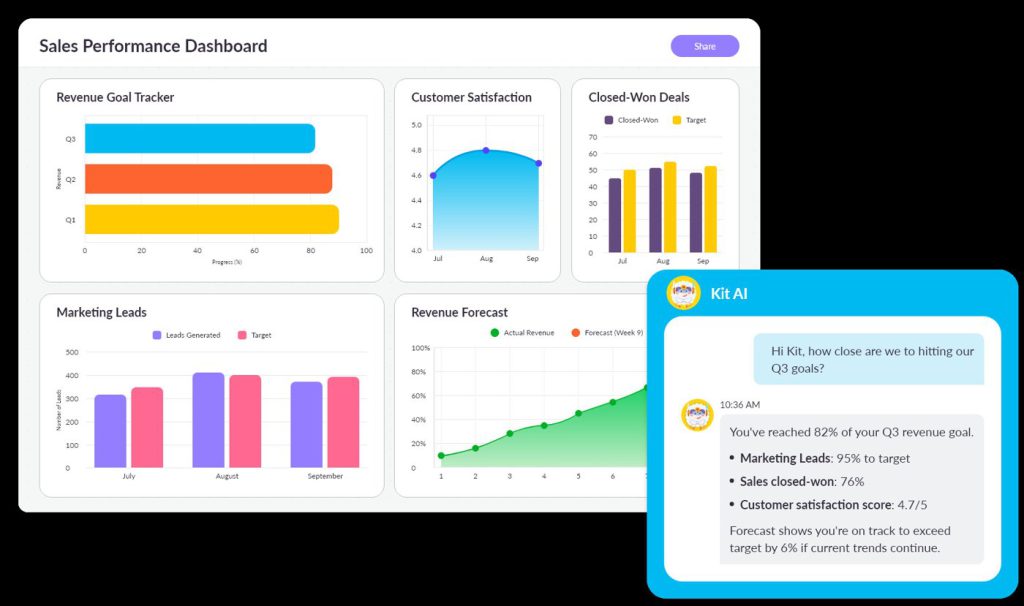
Sourcefit is also developing Knit, which it describes as an operating system for modern work and the orchestration layer connecting automation, people data and reporting. Its product deck lists HR, accounting, projects, CRM, recruitment and IT helpdesk in one platform, along with an AI assistant called Kit.
Another part of the system is PulseBI, which Sourcefit says connects people data with operational performance. Its SourceCX PulseBI draws on information collected in Knit, including training attendance and scores, coaching feedback and schedule adherence. Those signals are combined into a Pulse Score for each agent, covering predicted performance and risk. PulseBI then connects that score with contact-center measures such as average handle time, customer satisfaction scores and queue times. The aim, according to Sourcefit, is to help clients and teams address attrition risk or missed coaching before an agent leaves or performance erodes.
Schachtel says the company has seen the approach most clearly in customer experience operations. By connecting HR signals with live operational data, he says, the system can identify a burnout or attrition risk weeks before it becomes a resignation.
Sourcefit points to a direct-to-consumer eyewear client account that it says has remained above target for seven years. The company credits the result to linking coaching with quality assurance results, scheduling with occupancy and training with customer satisfaction. It describes PulseBI as the system that now makes those connections live.
In 2026, Knit and WorkingAI won a Gold Stevie at the Asia-Pacific Stevie Awards in the Excellence in Innovation in Artificial Intelligence category for organizations with 100 or more employees. Sourcefit was also named a winner in the Artificial Intelligence category of the 2026 Fortress Cybersecurity Awards, run by the Business Intelligence Group.
Governance built into the system

Sourcefit says it runs AI in production on sensitive client data. Its Fortress award announcement focused on an AI governance platform built by its internal technology team. The company says its controls are enforced at the database and credential layer before an agent can act: an AI agent can retrieve only the rows it is authorized to see, and every action is recorded. Where an action requires review, a person must approve it.
Sourcefit says its platform is aligned to ISO/IEC 42001, the international standard for managing AI responsibly. It also reports cutting the time needed for firewall queries and compliance validation by more than 95%. These are company-reported capabilities and results, so a buyer should ask what the controls cover and how they are demonstrated in the buyer’s own setting.
For workers, governance is relevant because AI tools may handle information or carry out tasks within everyday operations. Knowing who can access data, what actions are logged and when a person must approve an action can help make the workplace process clearer. A provider’s stated alignment with a standard is a starting point for questions, rather than a substitute for understanding how a particular system is used.
What the people doing the work say

In the survey, 74% of respondents said they use AI tools at least occasionally, while 52% said they use them daily or several times a week. The most frequently reported uses were writing and documentation (36%), research and analysis (30%) and customer support (14%).
Respondents also named barriers. Limited access to tools was the most common, at 30%, followed by security concerns at 20%. On the expected effect on their jobs, 41% believed AI would support their role without fundamentally changing it. The survey also found that 66% felt confident using AI daily.
Schachtel told the source publication: “People aren’t afraid of a tool that’s actually making them better at their job.” He argues that AI can narrow the output gap between offshore and onshore teams, while human cultural and social understanding remains valuable. He also says much AI output still needs humans in the loop. In that context, he connects the reported productivity gains to staff being able to use tools that help them do their work.
Because the survey was conducted by an employer among its own staff, the findings should be read as Sourcefit’s internal signal. They do not establish how workers at other providers feel or what will happen to every role. For job seekers, they do show why it is useful to ask about actual tools, access, training and human review rather than relying on broad claims that AI either replaces or improves every job.
“People aren't afraid of a tool that's actually making them better at their job.”Andy Schachtel · Founder & CEO, Sourcefit
What to ask a BPO before you sign

For a buyer considering an outsourcing provider, Schachtel recommends asking what recognized standard the provider’s AI governance is built to and requesting evidence that it is followed. He says ISO/IEC 42001 calls for ongoing documentation and review as a system changes. He also points to the EU AI Act as setting a bar in the year of the interview. His advice is that a provider should be able to name a standard and show how it applies, rather than simply say it takes AI seriously.
“A provider who can name a recognized standard and prove they meet it is in a different category from one who just says they take AI seriously,” Schachtel said.
A buyer can apply the same test to Sourcefit. The company names ISO/IEC 42001 as the standard its platform is aligned to; a practical conversation can then ask what documentation, review processes and controls demonstrate that alignment for the proposed work. The source also notes that tiers and AI badges in the BPO AI directory are earned, allowing buyers to see that a provider’s readiness has been checked rather than merely claimed.
For a Filipino applicant, similar questions can help clarify what a role involves: Which tools will the team use? What training or access is provided? Which tasks still require a person’s judgment? And how is performance assessed? The answers can help you judge the work itself instead of making a decision based only on an employer’s general AI messaging.
About Andy Schachtel
Andy Schachtel is the founder and CEO of Sourcefit, a global outsourcing company. His comments in the source feature frame the company’s AI strategy around combining automation with staff, operational data and governance. The survey figures and product descriptions in this article are Sourcefit’s own account of its work and workforce findings.
What this means for Filipino job seekers
Sourcefit’s findings do not guarantee that AI will protect any particular position, but they offer a concrete example of how one outsourcing provider says it is introducing the technology: integrating tools into workflows, tracking operational and people-related signals, and retaining human approval where needed. For candidates, the practical value of this Sourcefit AI work is a clearer set of questions to take into interviews: what tools workers use, what access and instruction they receive, and how human review works.
If you are preparing for a role that involves new technology, explore official TESDA skills and training information as one place to check vocational learning options. If you are considering overseas employment, use the Department of Migrant Workers’ official information and our guide to checking a recruitment agency in the Philippines when reviewing an opportunity. If an intermediary asks you for money, first review how to assess recruitment fees and protect yourself. And as you adapt to workplace change, our guide to protecting your mental wellbeing as an OFW offers practical support.
Your next step: shortlist roles that match your experience, then ask each employer specific questions about AI tools, training, human review and data controls before accepting an offer. Browse current opportunities on POEA Job Finder and assess each role on its actual duties and terms.